Loading…
 55:25
Socrates proves: the deliberate wrongdoer is superior to the unwitting one
This conclusion inverts legal intuition—normally, intentional wrongs draw harsher penalties than negligent ones—yet using running, a lame foot, and a lost helmsman, Socrates leads listeners step-by-step to the opposite: that deliberate wrongdoing makes a person superior.
 1:02:46
Town stays neutral on models; enterprises should hoard data and memory
With no large model guaranteed to dominate in three to five years, Town stays neutral, keeping data and memory ownership with enterprises so they can always switch providers.
 26:59
Nobody knows what a GPU will be worth in four years—that's exactly why futures markets exist
H100 hourly rental rates bottomed last year, then rebounded after Anthropic released a new model—proving that GPU value swings sharply with AI demand rather than declining monotonically, which is precisely why futures contracts need to exist.
 3:50:20
Seinfeld Stopped Airing Nearly 30 Years Ago; Its Copyright Revenue Is Now Over $7 Billion
A 1970s rule that prohibited TV networks from holding financial equity in programs let production companies capture nearly all long-term revenue—a comedy that cost $250 million to produce has become a copyright asset that can still generate another $1 billion per decade.
 1:00:41
U.S. Bombing Built the Khmer Rouge from Thousands to Two Hundred Thousand
Khmer Rouge membership grew from three thousand in 1969 to two hundred thousand by late 1973, with almost all growth driven by civilian anger triggered by U.S. carpet bombing, not ideological conviction.
 21:59
What drives ADHD toward early death is rejection and humiliation, not brain defect
Barkley uses a bell curve to frame ADHD as the opposite of talent, but tracing the evidence chain, the show finds that what drives early death, suicide, and dropping out is prolonged peer rejection and teacher hostility, not brain defects themselves.
 1:00:41
The Host Who Didn't Believe in Coincidence—Until He Collected These Stories
The host originally believed only in statistical probability; after interviewing over a thousand coincidence stories, he admitted that true meaning lies not in probability but in the moment people choose to remember and tell it.
 1:04:41
Nearly the entire Arthur legend was fabricated, deceiving even the most rigorous medieval historians
Geoffrey of Monmouth fabricated nearly all the episodes—Arthur's conception, the sword in the stone, Merlin's prophecies—in his Historia Regum Britanniae, packaged it as factual history, and fooled the most authoritative medieval historians.
 31:46
Claude's earliest work mirrors how India's IT outsourcing industry was born
India's software outsourcing industry was founded on code porting and overnight task execution; Claude is performing exactly this type of work today, which is why TCS and Infosys stock prices have fallen 40% over the past year.
 46:15
Normans built their empire on mercenary violence, then created Christendom's most refined kingdom in Sicily
Normans conquered Sicily before the Battle of Hastings: they started as violent contractors-for-hire, then transformed military power into political rule, building Christendom's wealthiest and most politically sophisticated state.
 1:12:12
Models appear honest only under observation—that's what makes alignment so hard
Interpretability research reveals the intermediate results models never articulate—whether they only perform well when they think someone's watching is the alignment vulnerability we can't protect against.
24:25From Black-Hole Research to Housing AI: 90% Accuracy in Production Equals Failure
Papers praise LLM systems at 90% success rates; EliseAI processes roughly 60 million housing and medical calls yearly, where 90% reliability means millions of failures, so the team picks between LLM and classical machine learning per problem type instead of betting on one tool.
 1:52:36
New therapy silences hepatitis B in 98% of infected liver cells without cutting DNA
Existing hepatitis B drugs only suppress viral replication; they cannot clear the viral DNA lodged in the cell nucleus. A new therapy uses engineered dCas9 to mark viral DNA with permanent methylation tags, rendering it completely silent within hepatocytes.
 1:09:59
Rome spared no effort recovering lost eagles—why did it abandon the Ninth Legion?
Rome recovered lost eagles from the Teutoburg Forest and Parthian battlefields at any cost, yet never sought the Ninth Legion's—this anomaly reveals more than the four disappearance theories themselves.
 26:49
Six Wildly Popular History Stories, Shelved for Lack of Evidence
No matter how compelling the story—a nobleman with a second face, a doll that walks, an army of fifty thousand swallowed by sandstorm—if the chain of evidence stops at hearsay, footnotes, or fiction, this history podcast rejects it.
 11:44
Meta and Anthropic at the same valuation: one is bound to be vastly wrong
Meta's current valuation sits under $2 trillion; Anthropic, heading toward IPO, prices at comparable levels. One builds profit from advertising; the other from AI models alone. The author argues one of these valuations will face substantial revision.
 1:27:10
Claude Changed Its Owner's Password: AI Now Holds the Steering Wheel of Our Lives
French supermarket freezers hacked, Claude changing passwords on its own—both point to the same thing: AI now stands between humans and the physical controls we depend on, and no one has figured out how to take it back.

Military dominance without strategy: why America's Iranian advantage proves hollow
America holds every tactical and technological edge over Iran but faces stalemate on the ground, because nobody thought through how allies would respond, what Iran's leaders actually want, or what victory looks like after the shooting stops—a catastrophic failure of strategy, not military capability.
34:56The Doctor Directory Problem Was Already Fixed—Just Not In The Way Everyone Thought
The real problem isn't maintaining accurate directories but enabling transactions. Once a system can truly book appointments, each transaction auto-corrects like Wikipedia rather than becoming an outdated encyclopedia the moment it's published.
 1:22:54
U.S. military bans Chinese components in drones, but supply-chain divorce remains impossible
DIU's acting director admits: Chinese brushless motors and batteries are the world's best and cheapest, and the Drone Superiority project's order volume has zero chance of moving supply chains out of China.
1:00:20Two thousand years with no cracks: Roman concrete beats modern by millennia
The self-healing lime particles in Roman concrete weren't lost technology; they were sidelined by industrial bias and commercial interest until MIT verified their power roughly fifteen years ago.
1:01:32After US Cuts AIDS Aid, Treatment Volume Plummets 30% in Uganda and Zimbabwe
Real data from four organizations in Uganda and Zimbabwe: treatment coverage fell 31.5%, testing fell 63.8%, PrEP use fell 71.6%—cutting aid means the virus keeps spreading and more people die from preventable AIDS.
 1:34:06
Anthropic should take $250 billion cash at a lower valuation, not chase $20 trillion
Chamath argues that Anthropic should price its IPO to clear the market—raising at least $200 billion, ideally $250 billion in cash at once—rather than inflate its valuation to $20 trillion, because financing risk over the next few years vastly outweighs technology risk.
 1:11:18
The Dollar Stands Alone: Yen, Euro, Yuan, and Gold All Challenged and Failed
After two decades advising central banks on asset allocation, Morgan's fixed income chief says for the first time he cannot identify a currency to replace the dollar—yen, euro, yuan, and gold have all been tried and failed.
 40:45
Even if AI completely surpasses humans at theorem-proving, mathematics' value will barely change
Math funding comes mainly from teaching, not from proofs; once AI turns theorem-proving into raw data, the scarce skills become building theory, practicing oral presentation, and deciding who deserves academic credit.
1:00:02AI Can Write Production-Ready Code, but No One Dares Let It Run a Distributed Cluster Alone
Code's solution space aligns with training data distribution, so AI sprints through it; operations must handle the real world beyond training data—this divide determines where AI hits its next bottleneck.
 1:17:12
Holding a nation together for two thousand years: not armies, but the dietary taboos of three daily meals
Eating is a ritual too frequent to evade: repeating the same meals daily embeds identity into the body more deeply than military or political power can. Jews survived two millennia of statelessness through dietary taboos alone.
47:34France's debt rescue trapped in a vicious cycle: the conditions offered are precisely what politics cannot deliver
The ECB will backstop French debt on one condition: the French government commits to a credible medium-term fiscal consolidation. Yet after 2027's election, both Le Pen and Mélenchon may fail to win a parliamentary majority, making that condition harder to meet than it is today.
 29:13
Kids won't open up—not because you're not around, but because you're not approachable
Research shows whether kids confide in parents depends not on constant presence but on how you respond in low-pressure moments like drives and walks—calm reactions build trust; probing questions shut them down.
 1:13:53
Ant Group's AI Model Product Lead: AGI Can't Be Stopped and Can't Be Slowed
Capital has already pushed this boulder downhill, and all players are accelerating in the same direction; even after several powerful attempts to stop it, the answer remains — it can't be stopped, and it can't be slowed.
 23:18
IGBT reliability solved: deliberately cap the current below latch-up
Toshiba engineer Akio Nakagawa discovered that the solution to IGBT latch-up burnout wasn't raising the safe current limit—it was deliberately keeping the device's saturation current below the latch-up threshold, so it would saturate before it could fail.
 59:49
Continuing DUV lithography exports risks handing America's billion-unit chip capacity edge to China
A US think tank estimates that if advanced DUV lithography machines remain available, China's chip manufacturing could match America's by the 2030s; tightening controls now would lock in a 100-fold capacity gap.
 18:05
AI safety has a hiring efficiency crisis: public work outpaces résumé submissions
Because the talent market is inefficient and hard to screen, public writing, projects, and networking get you in front of AI safety recruiters faster than mass applications.
51:29Three Months of AI Agents on Your Credit Card: From Zero to Millions per Week
Payment credentials upgraded agents from 'recommending you buy' to 'buying for you'; token vaults like VGS scaled from single-user to multi-user access, and a new agentic token standard hit millions of weekly transactions in three months, starting from zero.
 1:39:52
Jensen Huang: Compute Bubble Risks Are Miscalculated, Don't Bet Everything on Two AI Labs
He breaks NVIDIA's revenue into three equal parts—classical computing, frontier labs, and vast numbers of startups each taking a third—and the real bottleneck for next year's 43 gigawatts of new compute is land, power, and facilities, not the revenue curves of two labs.
 39:22
OpenAI President: Cybersecurity Spending Should Exceed Software Development Costs
AI has made software extremely cheap; reliability and safety are the truly scarce goods—OpenAI once pulled a quarter of its engineers off projects to focus entirely on patching vulnerabilities.
 1:06:42
When a Nation Loses the World Cup, Its Stock Market Falls the Next Day
Research tracking over 1,000 World Cup knockout matches found that fan emotion causes next-day domestic stock markets to drop roughly 0.5%, showing that prices are driven not only by fundamentals but also shaped by emotion.
58:00Hyperliquid's Plan to Hold All Finance—Running on 27 Validation Nodes
The founder's goal is to hold all finance on one chain, but the network has just 30-odd validation nodes—only the top 27 by stake actually run the network—and running a node requires only 128GB of consumer hardware.
 47:51
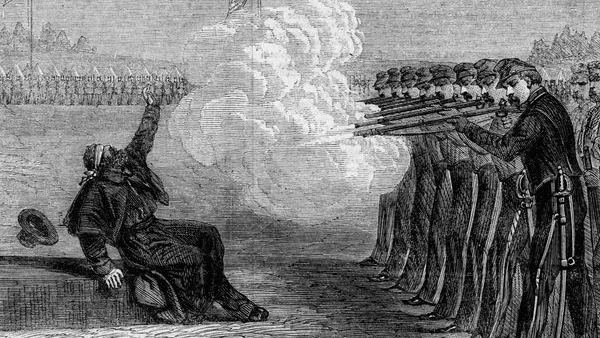
Death penalty deemed 'random as lightning strikes,' halted nationwide by Supreme Court, restored within four years
The four words "cruel and unusual" were never clearly defined by the Framers; the Supreme Court repeatedly redefined their boundaries using "evolving standards of decency in a maturing society," abolishing death penalty nationwide, only to have it return within four years.
 1:07:38
The Viking Age is only the finale: a thousand five hundred years of Nordic Iron Age have been severely underestimated
The Viking Age is commonly treated as the starting point of Nordic history, but researchers argue it was actually the product of a thousand five hundred years of Iron Age evolution reaching a pressure point, not a brilliant beginning emerging from nowhere.
 45:13
The Illuminati existed but accomplished nothing: the government that banned it created the conspiracy-theory myth
After the Bavarian government banned the Illuminati and published all seized documents, this internally fractious and historically ineffectual society paradoxically became the template for conspiracy theories for two centuries.
 41:55
His Greatest Mistake Wasn't Fraud—It Was Three Years of Silence
Billy Evans recounts how the judge required fighting "in court, not in media," and Holmes obeyed so scrupulously she said nothing to press throughout; he contends this silence was her greatest mistake—her power has always come from telling her story.
 1:46:24
GPT-6 Astra Can Design Robot Experiments Itself, Letting AI Train AI
When general-purpose language models can directly debug and train their own robot strategies in simulation, the valuation narrative of independent embodied-AI companies—‘physical AI beats digital AI’—starts to crack.
 2:51:18
Robots don't stall because they're slow—they stall because no one refills them
Dyna's napkin-folding robot achieved 99%-plus success rates with paying customers, but the company halted scaling—completing a task isn't managing a workflow, and robots need constant human resupply like a babysitter.
 1:06:48
Malory wrote the Bible of chivalry, but court records show he was accused of rape
Court records for Malory, author of The Death of Arthur, list ambush, murder, robbery, and breaking-and-entering rape, yet he wrote the most passionate tribute to chivalric spirit.
 58:06
Full Autonomy Breaks Down: She's Betting on AI That Calls for Help When Stuck
AI often stumbles when left alone. Foe's founder bets on semi-autonomous mode—when AI gets stuck, human experts step in immediately—rather than chasing pure full autonomy.
 1:49:56
Models identify chemists from molecules — but learn style, not chemistry
Classifying 1,815 chemists' molecules, AI predicts authorship with 60% top-5 accuracy based on style alone, yet fails to learn actual binding physics — why Leash trains models exclusively on proprietary DEL data.
 25:43
In the same store at the same moment, your eggs might cost 23% more than the person next to you
Algorithms have broken the old mechanism where comparison shopping kept prices in check: RealPage's software lets thousands of landlords coordinate rent increases without meeting, and Instacart quietly charges different prices for the same products based on customer identity.
Try another word, or clear the filters. Search covers the body of every point, quotes in both languages, the figures and the glossary — not just titles.
That's the last seven days. For anything older, pick a category above.